Knowledge Hub
Floor coating questions, answered.
Everything homeowners and business owners in Northern Colorado ask us about epoxy, flake, metallic, and polyaspartic floor coatings — cost, durability, surface prep, install time, maintenance, and warranty. Search below or browse by topic.
Cost & Quotes
What floor coatings cost in Northern Colorado and how we quote.
A professionally installed coating for a typical 2-car garage in Northern Colorado runs about $2,800 to $4,500. Pricing depends on square footage, the condition of the existing slab, how much crack and spall repair is needed, your color and flake package, and add-ons like cove base or moisture mitigation. A 3-car garage usually lands between $4,500 and $6,500. We provide a written, itemized quote within 24 hours of your on-site estimate, with no hidden fees.
A big-box DIY kit costs $150 to $300 but uses thin, water-based epoxy and no real surface prep, which is why those floors typically peel and lift within a year or two. A professional system costs more because it includes diamond grinding, crack and spall repair, commercial-grade 100% solids resin, and a UV-stable polyaspartic topcoat installed by a trained crew. You are paying for a floor that lasts 15 to 20+ years instead of one season.
Yes. Every estimate is free and comes with no obligation. We come to your home or business, measure the space, inspect the slab condition, discuss color options, and send a detailed written quote within 24 hours. There is no high-pressure sales pitch.
For larger residential and commercial projects we can discuss payment scheduling. Reach out through our contact page with your project details and we will walk you through the options that fit your timeline and budget.
Durability & Performance
How these floors hold up to tires, chemicals, weather, and time.
A properly prepped and professionally installed system lasts 15 to 20+ years in a residential garage, and many last far longer with basic care. The lifespan comes down to two things: mechanical surface prep that creates a true bond to the concrete, and commercial-grade materials. Both are standard on every floor we install.
No. Hot-tire pickup is the number-one failure point for DIY kits and cheap installs, where the tire literally pulls the coating off the slab. Our systems use 100% solids resin that is diamond-ground into the concrete, creating both a mechanical and chemical bond. There is nothing for a hot tire to grab and lift.
Our standard flake systems have a fine pencil-tip texture from the broadcast chips that provides solid traction even when wet. For wash bays, ramps, entryways, or commercial kitchens, we can add an aluminum oxide or polymer grit additive to the topcoat to increase slip resistance to whatever the environment requires.
Standard epoxy yellows under UV exposure, which is why we top every system with a UV-stable polyaspartic. That topcoat keeps colors true and prevents the ambered, yellowed look you see on older epoxy-only floors, even in garages with lots of natural light or south-facing doors.
Yes. The cured surface is non-porous and resists motor oil, gasoline, brake fluid, road salt, antifreeze, and most household and automotive chemicals. Spills wipe up instead of soaking into the concrete and staining it. For specialized industrial chemical exposure, we can spec a more aggressive resin system.
It does. Our systems are built specifically for Colorado conditions, including freeze-thaw cycling and the salt and magnesium chloride that come off winter vehicles. The non-porous surface stops moisture and de-icer from penetrating and cracking the slab, which is a common failure mode for bare concrete here.
Installation & Process
What actually happens on install day and how long it takes.
Most 2-car and 3-car residential garages are completed in a single day. We grind in the morning, repair cracks and spalls, broadcast the flake or pour the metallic, and finish with the polyaspartic topcoat. Larger commercial floors are scheduled in phases around your operations to minimize downtime.
Because our polyaspartic topcoat cures fast, most floors are walkable the same evening. You can return light foot traffic the next morning and park vehicles back on the floor after about 24 hours. We give you exact return-to-service times for your specific project before we leave.
Yes. The slab has to be completely clear for grinding and coating. We send a simple prep checklist about a week before your install date. If you have heavy items like a workbench or vehicle lift, let us know and we can advise on the best way to handle them.
Every floor is installed by our own in-house crew, with the owner on site for each project. The team that quotes your floor is the same team that grinds, repairs, and coats it. We never hand your project off to a subcontractor.
Diamond grinding does create concrete dust, but we run dust-shrouded grinders connected to HEPA vacuums to keep airborne dust to a minimum. We protect adjacent surfaces, contain the work area, and clean up completely before we leave.
Surface Prep & Repair
Why prep is the part that actually makes a coating last.
Prep is the single biggest factor in whether a coating lasts decades or fails in a season. A coating can only bond as well as the surface underneath it. Skipping or shortcutting prep is the reason most failed floors fail. We never acid-etch as a shortcut; we mechanically profile every slab.
Diamond grinding uses industrial diamond-segment discs to remove the smooth top layer of the concrete and open up its pores, creating a textured profile the coating can mechanically lock into. It is the industry gold standard for surface prep and dramatically outperforms acid etching, which many low-cost installers use because it is faster and cheaper.
Yes. After grinding, we fill and repair cracks, spalls, pits, and divots with high-strength polymer patching compounds before any coating goes down. This is included in our process. Badly damaged slabs may need additional repair, which we will flag and price in your written quote.
We can grind off most existing paint and failed coatings as part of surface prep. We will assess the existing material during your estimate and include any extra removal labor in the quote so there are no surprises on install day.
Concrete slabs can transmit moisture vapor that breaks the bond of a coating over time. If we detect a moisture concern, we can install a moisture-mitigation primer designed to handle vapor transmission before the build coats go down. We test for this rather than guessing.
Coating Systems
Epoxy vs polyaspartic vs metallic, and which is right for you.
Epoxy is the basecoat workhorse: high-build, strong, and excellent for color and body. Polyaspartic is the topcoat champion: UV-stable so it will not yellow, fast-curing, and extremely abrasion-resistant. Most of our systems combine both, using epoxy for color and build and polyaspartic for the durable wear surface. You get the strengths of each.
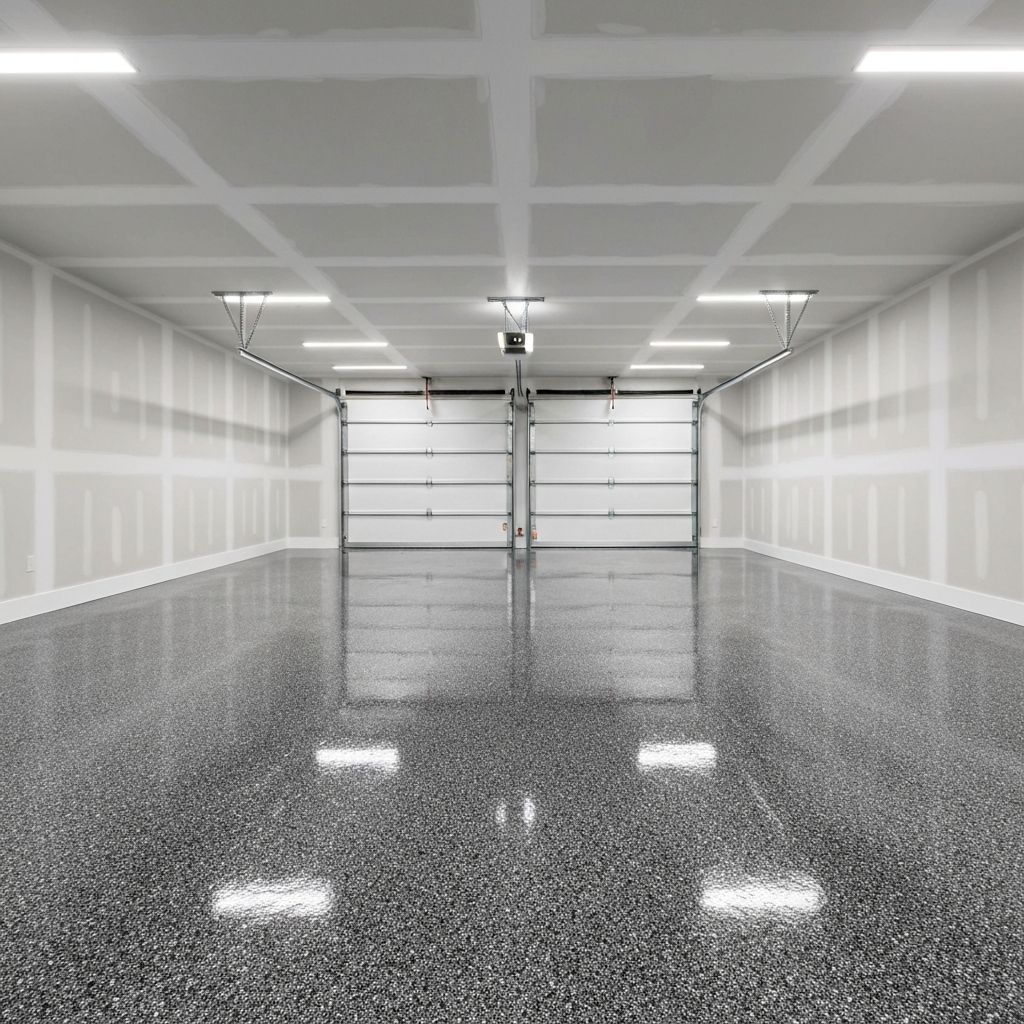
A flake floor is created by broadcasting vinyl color chips into the basecoat, then sealing them under clear topcoats. The flakes add traction, hide minor slab imperfections, and let you customize the color blend. It is our most popular residential system because it looks great and wears extremely well.
Metallic epoxy uses pigmented metallic powders suspended in the resin to create a glossy, three-dimensional, marbled look with depth and movement. It is a premium, high-design finish popular in showrooms, retail spaces, and high-end garages where appearance is a priority.
For most homeowners, a full flake system with a polyaspartic topcoat is the best balance of durability, traction, looks, and value. If you want a high-end designer appearance, metallic is the upgrade. For heavy commercial or industrial traffic, we spec a system around your specific load and chemical exposure. We will recommend the right fit during your estimate.
Yes. We coat warehouses, auto shops, showrooms, commercial kitchens, retail spaces, and more. Commercial systems are engineered around traffic load, chemical exposure, and slip requirements, and we schedule the work to minimize disruption to your operations.
Maintenance & Warranty
Keeping the floor looking new and what our warranty covers.
Maintenance is easy. Dust mop or blow out debris as needed, and damp mop with a pH-neutral cleaner or simple soap and water when it needs a deeper clean. Wipe up oil and chemical spills when you notice them. No waxing, resealing, or special products are required for normal residential use.
Yes. Our residential floor systems come with a lifetime adhesion warranty, and commercial systems are warrantied based on the spec and traffic load. Because we control prep, materials, and installation ourselves, we can stand behind the work in writing without the fine print that voids most coatings.
Yes. Our lifetime residential warranty is fully transferable to the next owner of the property. It is a genuine selling point when you list your home, and it is provided in writing.
We are based in Fort Collins and serve all of Northern Colorado, including Loveland, Greeley, Windsor, Timnath, Wellington, Berthoud, and Severance. For larger commercial projects we travel beyond that radius. Visit our Service Areas page for city-specific details.
Ready to start?
Free quote. Same-day response.
Tell us about your space — we'll send a tailored estimate and schedule a free walkthrough.